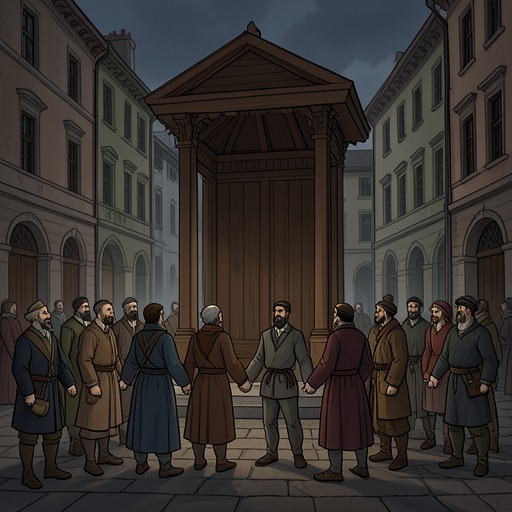
General Will–Will of All distinction
The Social ContractThe General Will–Will of All distinction is the difference between a political will oriented toward the common interest and a sum of individual wills pursuing private interests. It is central to Jean-Jacques Rousseau’s account of popular decision-making: the General Will remains directed toward public advantage, but a people’s deliberations can be mistaken, misled, or captured by factions, so a majority vote is not automatically its expression.
Definition and Political Purpose
The distinction turns on what a collective decision takes into account. The Will of All adds together particular preferences, including private interests; the General Will considers the common interest shared by citizens. Rousseau describes the latter as what remains when opposing advantages and disadvantages among individual wills cancel one another. The two can therefore produce different results even when both emerge from the same population.
This distinction addresses a difficulty in the idea that the political community has a will directed toward preserving and benefiting the whole. Individuals can pursue their own advantage against the public good, and even a unanimous decision may express shared selfishness rather than a General Will. Agreement alone is not enough: the relevant test is whether the decision answers the question of what benefits the State, rather than what benefits a person or party.
Deliberation, Error, and Faction
Rousseau distinguishes the rightness of the General Will from the fallibility of popular deliberation. The people may will its own good without correctly recognizing what that good is; it is deceived, rather than corrupted, when it appears to will what is harmful. This allows him to maintain that the General Will tends toward public advantage without treating every decision made in its name as correct.
Under ideal deliberative conditions, citizens have adequate information and do not communicate with one another. Their separate judgments then produce small differences that cancel, leaving a result that expresses the common interest. The ideal depends not on the mere count of votes but on the structure of deliberation that prevents private interests from combining into organized power.
Factions and partial associations disrupt that structure. Each association may form a common will for its own members, but, in relation to the State, that will remains particular. As associations reduce many individual votes to a smaller number of organized positions, the differences that might have canceled become fewer, and the result becomes less general. If one association grows large enough to dominate the rest, its position prevails as a single particular will: at that point, there is no General Will.
Voting and the Public Question
The assembly’s task is not simply to preserve the General Will, as though it could be secured by proclaiming it. It must ensure that the question put to citizens is genuinely about the public interest and that their answers address that question. A voter who substitutes a private or partisan calculation answers something different from what the assembly is asking; that vote does not destroy or alter the General Will, but obscures its political expression.
Rousseau therefore does not claim that a majority is infallible. Majority voting is expected to yield the General Will only under the ideal conditions he describes, including the absence of factions that can coordinate private interests. The distinction marks both the aspiration of popular judgment and the limits of treating numerical agreement as proof that the common good has been found.
Connection to the Social Compact and Liberty
The distinction belongs to a broader account of association. The social compact is meant to unite people’s forces so that the person and goods of each associate are protected by the common force, while each remains free. Its terms involve each person’s complete transfer of rights to the community on equal conditions; the resulting civil order is not simply an alliance of private wills, but a body whose laws are grounded in a public will.
That order also addresses the conflict between a citizen’s particular will and the General Will. A person may want the benefits of citizenship while treating obligations to the common cause as a burden owed to an impersonal State. Rousseau argues that the compact tacitly includes the power to compel obedience to the General Will. Such compulsion is presented as securing citizens against personal dependence: civil liberty is limited by the General Will, while moral liberty consists in obeying a law prescribed to oneself. The distinction thus gives the common will a role in defining both legitimate public authority and the freedom the political association is meant to protect.
Sovereignty and Representation
Because sovereignty lies in the General Will, Rousseau argues that it cannot be represented. Will cannot be divided between an original and an equivalent representative expression: it is either the same will or another. Deputies may act as stewards, but they cannot make definitive laws on the people’s behalf; a law not ratified by the people in person is null and void.
This argument connects the distinction to the practical conditions of popular sovereignty. Representation can place private interests ahead of the public interest, while direct ratification keeps lawmaking answerable to the people whose common will gives it authority. Rousseau’s sharp contrast between these forms does not erase the problem of erroneous deliberation: popular participation matters, but only deliberation oriented toward the common interest can express the General Will.